
When shopping for a new air conditioner in Texas, you’ll quickly encounter terms such as:
- Single-stage
- Two-stage
- Variable-speed
- Variable-capacity
- Inverter
These aren’t just marketing terms. They describe how an air conditioner’s compressor adjusts cooling capacity as the cooling demand in your home changes.
And in Texas, where an AC system may operate for many hours during the summer, the difference can affect:
🌡️ Indoor temperature consistency
💧 Humidity control
🔇 Noise
⚡ Energy consumption
💰 Upfront price
🛋️ Overall comfort
So, should you save money with a single-stage AC, upgrade to two-stage, or invest in a variable-speed system?
The answer depends on your home, budget and comfort priorities.
Quick Comparison: Single-Stage vs. Two-Stage vs. Variable-Speed
| Feature | Single-Stage | Two-Stage | Variable-Speed |
|---|---|---|---|
| Compressor operation | 100% or OFF | Low + High | Continuously adjusts |
| Typical capacity range | 100% | Approximately 60–70% / 100%* | Some models approximately 30–100%* |
| Temperature control | Good | Better | Best |
| Humidity control | Basic | Better | Best |
| Sound level | Standard | Quieter at low stage | Usually quietest at low capacity |
| Energy efficiency | Standard | Higher potential | Highest potential |
| Upfront cost | $ | $$ | $$$ |
| Technology complexity | Lowest | Moderate | Highest |
| Best for | Budget-focused replacement | Comfort/value balance | Premium comfort & efficiency |
*Exact operating capacity varies by manufacturer and model. Carrier, for example, describes many two-stage systems as operating around 65% on low stage and variable-capacity equipment as capable of operating from approximately 30% to 100%. Trane publishes similar ranges for its current equipment.
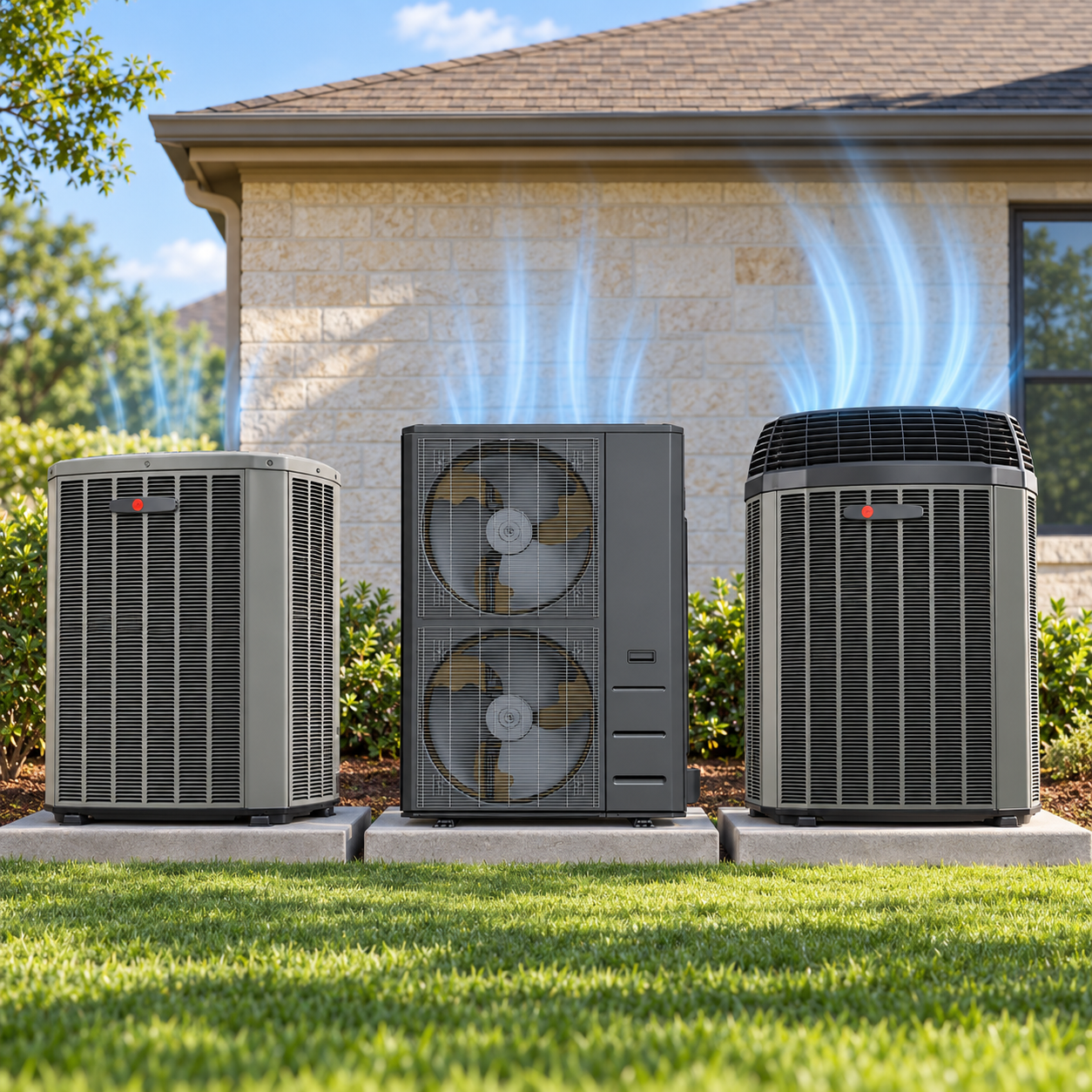
Single-stage → Two-stage → Variable-speed
Single-stage, two-stage and variable-speed air conditioners differ primarily in how precisely the compressor can match cooling output to the home’s demand.
What Does “Stage” Actually Mean?
The easiest way to understand the difference is to think about how much cooling capacity the compressor can deliver.
🔵 Single-Stage = Light Switch
A single-stage compressor has two operating conditions:
OFF
or
100%
When the thermostat calls for cooling, the compressor starts at full capacity.
When the thermostat is satisfied, it shuts off.
Carrier and Trane both describe single-stage equipment as essentially 100% on or completely off.
🟠 Two-Stage = Low / High
A two-stage compressor has:
LOW
and
HIGH
During moderate cooling conditions, the system can operate at reduced capacity.
When the cooling demand increases—for example, during a hot Texas afternoon—the compressor can switch to full capacity.
Low stage is commonly around 60–70% of full capacity, although the actual percentage depends on the equipment.
🟢 Variable-Speed = Dimmer Switch
Instead of choosing between one or two fixed capacities, a variable-speed or variable-capacity compressor can adjust its cooling output over a much wider range.
Some current residential systems can modulate from roughly 30% to 100% capacity, depending on model and operating conditions.
Rather than repeatedly turning completely on and off, the system can run longer at a lower output and increase capacity when the home needs more cooling.
🚦Think of It Like Driving a Car
Imagine trying to maintain 65 mph.
Single-Stage
Your only choices are:
Full throttle → coast → full throttle → coast
Two-Stage
You now have:
Moderate throttle → full throttle → moderate throttle
Variable-Speed
You adjust the accelerator continuously:
Exactly as much power as needed to maintain speed.
That’s essentially what advanced compressor control allows your AC to do with indoor temperature.
1. Single-Stage AC: Simple and Affordable
A single-stage air conditioner is the traditional residential cooling system.
When cooling is needed:
100% capacity ON
When cooling isn’t needed:
OFF
✅ Advantages
💰 Lowest initial equipment cost
🔧 Simpler technology
🛠️ Generally straightforward to service
❄️ Can provide excellent cooling when properly sized
🏠 Good choice for budget-conscious homeowners
❌ Disadvantages
🌡️ More noticeable temperature swings
💧 Less precise humidity control
🔊 Full-capacity operation every time it starts
🔁 More on/off cycling compared with modulating systems
⚡ Usually lower efficiency potential than advanced equipment within the same product family
Is Single-Stage AC Bad for Texas?
No.
This is important.
A properly sized and properly installed single-stage system can cool a Texas home very well.
A single-stage system may make excellent financial sense when:
- Upfront cost is the priority
- You’re replacing equipment in a rental property
- You don’t plan to remain in the home long-term
- The house has relatively simple cooling requirements
- Premium humidity and sound control aren’t priorities
- The price difference to higher-level equipment is substantial
Buying more complicated equipment isn’t automatically the best financial decision.
2. Two-Stage AC: The Middle Ground
For many Texas homeowners, two-stage equipment offers an attractive compromise.
Instead of running at full output during every cooling call, the compressor can operate at a lower stage when the cooling demand is moderate.
Carrier describes low-stage operation on many two-stage systems as approximately 65% capacity, with high stage providing full capacity.
That means the system can spend more time operating gently instead of continuously cycling between full power and off.
✅ Advantages
🌡️ More consistent temperatures
💧 Improved humidity control
🔇 Quieter operation while in low stage
⚡ Better efficiency potential
🔁 Longer cooling cycles
💰 Less expensive than premium variable-capacity equipment
❌ Disadvantages
💵 Higher upfront cost than single-stage
🔧 More components and controls
📊 Only two capacity levels—not true continuous modulation
Why Longer AC Cycles Can Be Better
Homeowners sometimes think:
“The best AC is the one that cools the house as fast as possible.”
That’s not necessarily true.
For comfort, a properly sized system running a longer, controlled cooling cycle can be better than an oversized system rapidly turning on and off.
Longer cooling cycles give air more time to move through the evaporator coil and remove moisture.
This is particularly useful when outdoor conditions are warm and humid.
Carrier notes that two-stage systems can provide improved dehumidification because they spend more time operating at lower capacity.
⚖️ SHORT CYCLES vs. LONGER CONTROLLED CYCLES
| Short Full-Capacity Cycles | Longer Lower-Capacity Cycles |
|---|---|
| 🌡️ Larger temperature swings | 🌡️ More stable temperature |
| 💧 Less dehumidification time | 💧 More moisture removal |
| 🔊 Frequent full-power starts | 🔇 Quieter low-stage operation |
| 🔁 More starts/stops | ➡️ More continuous operation |
| 💨 Sudden airflow | 🌬️ More consistent airflow |
Long runtime does not automatically mean something is wrong with a two-stage or variable-capacity system.
Advanced systems are often designed to operate this way.
3. Variable-Speed AC: Maximum Comfort and Control
Variable-speed systems take the same concept much further.
Instead of:
OFF → 100%
or:
LOW → HIGH
the compressor continually adjusts its cooling capacity.
Trane says its variable-speed equipment can operate across a broad range—from roughly 30% to 100% capacity on applicable models—allowing more precise temperature and humidity control.
Carrier describes variable systems similarly, with the compressor continuously adjusting output to match the cooling load.
Example
Imagine your home has a 3-ton AC system.
That doesn’t mean the house requires the full 3 tons of cooling every minute of every summer day.
At one moment it may need relatively little cooling.
Later it may need significantly more.
And during an extremely hot afternoon it may need nearly the system’s full capacity.
Single-stage:
Full output or nothing
Two-stage:
Reduced output or full output
Variable-speed:
Adjust output much more closely to actual demand
That’s the major advantage.
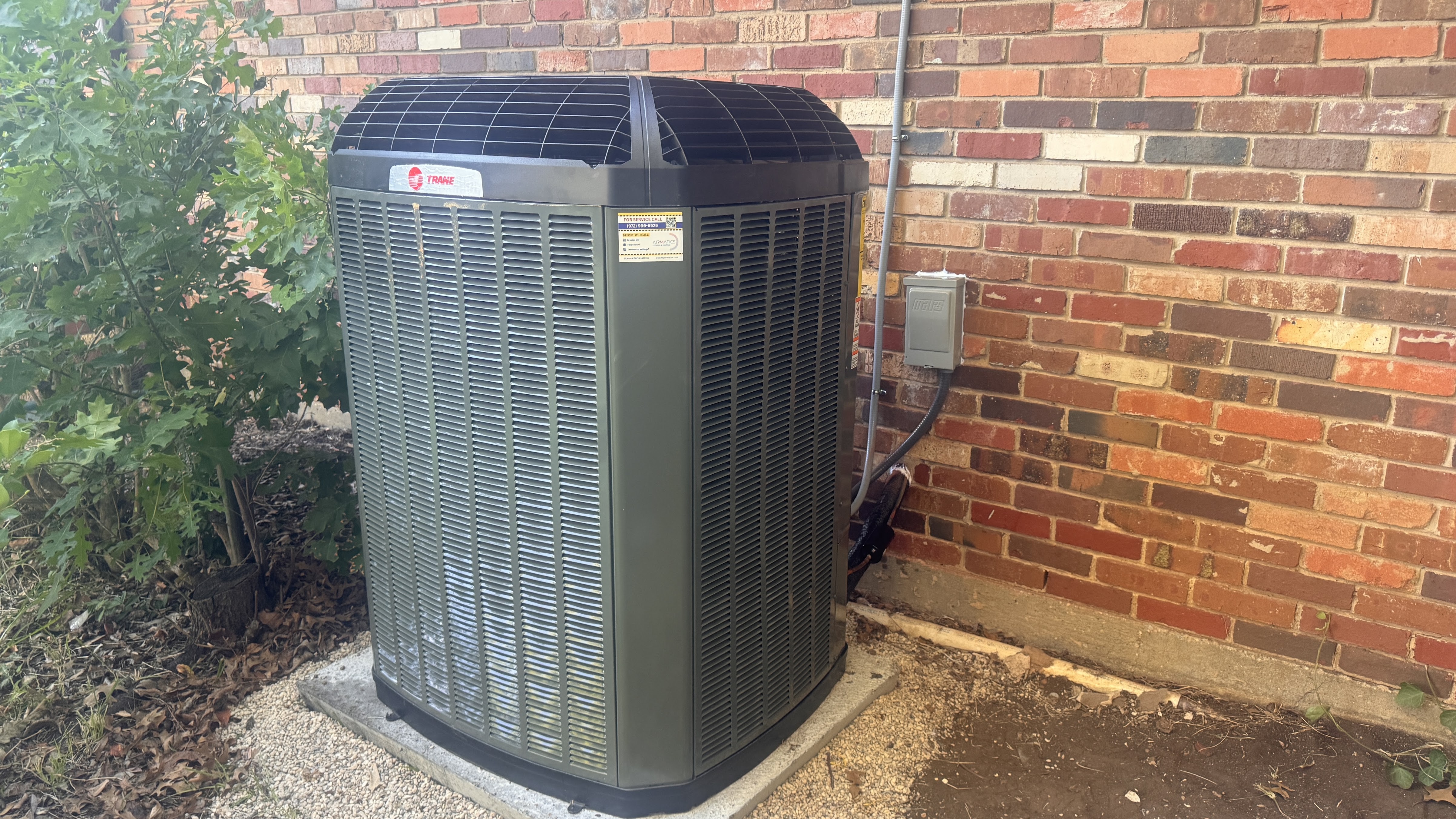
A variable-capacity compressor can increase or decrease cooling output as the home’s cooling demand changes.
Why Variable-Speed Can Feel More Comfortable
The major advantage isn’t simply the efficiency rating.
It’s load matching.
Instead of allowing the home to warm up and then delivering a large burst of cooling, the system can continuously provide approximately the amount of cooling needed.
That generally produces:
🌡️ More stable indoor temperature
💧 Better humidity management
🌬️ More consistent airflow
🔇 Lower sound levels during reduced-capacity operation
⚡ Higher efficiency potential
Carrier specifically highlights more precise temperature control, longer operation at lower speed and improved humidity removal as major advantages of variable-speed technology.
💧 Which System Controls Humidity Best?
Generally:
🥉 Single-stage
Basic
🥈 Two-stage
Better
🥇 Variable-speed
Best
Why?
Moisture removal occurs when humid indoor air passes across the cold evaporator coil and water condenses out of the air.
Longer cooling cycles can provide more opportunity for dehumidification.
Variable-capacity equipment can operate at reduced output for extended periods rather than satisfying the thermostat very quickly and shutting down.
Carrier specifically identifies humidity control as one of the main advantages of variable-speed systems.
🌡️ Why This Matters in Texas
Texas cooling isn’t just about reaching a thermostat setting.
Comfort depends on both:
Temperature
and
Humidity
A home at:
74°F with controlled humidity
can feel significantly different from a home at:
74°F with high indoor humidity.
That means homeowners shouldn’t evaluate AC equipment based on thermostat temperature alone.
🔇 Which AC Is Quietest?
Generally:
Variable-speed → Two-stage → Single-stage
A single-stage condenser operates at full capacity whenever it turns on.
A two-stage condenser can spend substantial time operating on its quieter low stage.
A variable-capacity condenser can often operate at substantially reduced output during light cooling conditions.
Carrier’s current equipment lineup illustrates this difference: its premium variable-speed models can have substantially lower published sound ratings than its basic single-stage equipment, although actual sound levels vary considerably by specific model.
This can matter if the condenser is near:
🛏️ A bedroom
🪟 A window
🏡 A patio
🏊 A pool area
🏘️ A neighboring property
⚡ Which One Uses Less Electricity?
This question requires some nuance.
It is tempting to say:
Variable-speed is always cheaper to operate.
But homeowners should compare the actual equipment efficiency ratings, not the compressor technology alone.
Look for:
SEER2
Seasonal Energy Efficiency Ratio 2
and
EER2
Energy Efficiency Ratio 2
Trane notes that SEER2 measures seasonal cooling efficiency, while EER2 evaluates efficiency at a specific 95°F test condition. It also points out that EER2 can be particularly relevant when comparing equipment in very hot climates.
⚠️ Staging Is NOT the Same Thing as SEER2
Two systems can use different compressor technology and still have efficiency ratings that overlap.
Therefore:
❌ Don’t assume every two-stage AC beats every single-stage AC.
❌ Don’t assume every variable-speed AC provides the same efficiency.
Compare the actual matched-system ratings.
Look at:
- SEER2
- EER2
- Compressor technology
- Indoor blower
- Coil match
- AHRI-rated system combination
- Actual installed cost
💰 Which System Costs More?
As a general equipment comparison:
| System | Relative Upfront Cost |
|---|---|
| Single-stage | $ |
| Two-stage | $$ |
| Variable-speed | $$$ |
Carrier and Trane both position single-stage equipment as the lower-cost option, two-stage as a middle tier, and variable-speed as the premium choice.
But price alone doesn’t determine value.
A homeowner should evaluate:
Purchase price
vs.
Comfort + efficiency + expected ownership period
Which One Provides the Best Value?
For many Texas homeowners, I would think about it this way:
💵 BEST BUDGET CHOICE
Single-Stage
Choose it when:
- Lowest upfront price matters most
- You want straightforward equipment
- The home isn’t difficult to cool
- Premium comfort isn’t necessary
- You’re unlikely to remain in the property long enough to justify a major upgrade
⚖️ BEST BALANCE
Two-Stage
Choose it when:
- You want noticeably better comfort
- Humidity control matters
- You want quieter operation
- You want improved efficiency without jumping to the most expensive equipment
- This is your primary residence
For many homeowners, this is the sweet spot between price and comfort.
🏆 BEST COMFORT
Variable-Speed
Choose it when:
- You prioritize temperature consistency
- Humidity control is important
- You want quieter operation
- You’re planning to remain in the home long-term
- You want premium equipment
- Higher initial cost fits the budget
🏠 Which AC Would We Choose for Different Texas Homes?
| Situation | Good Starting Choice |
|---|---|
| Rental property | Single-stage |
| Budget replacement | Single-stage |
| Typical primary residence | Two-stage |
| Long-term home | Two-stage / Variable |
| Homeowner highly sensitive to temperature swings | Variable |
| High indoor humidity concerns | Two-stage / Variable |
| Condenser near bedroom/patio | Two-stage / Variable |
| Premium comfort priority | Variable |
| Poor ductwork | Fix ductwork first |
| Significant room-to-room temperature problems | Evaluate ductwork/load before equipment upgrade |
The important words here are starting choice.
The house itself still needs to be evaluated.
⚠️ A Variable-Speed AC Cannot Fix Bad Ductwork
This is one of the most important points in this article.
Installing premium equipment doesn’t automatically solve:
- Undersized return ducts
- Crushed flexible ducts
- Disconnected ducts
- Poorly designed supply runs
- Missing balancing dampers
- Excessive static pressure
- Major air leakage
- Poor insulation
- Inadequate return-air paths
A $15,000+ premium HVAC system connected to badly designed ductwork can still produce poor comfort.
Equipment and ductwork must work together.
ACCA’s residential design standards separate this process into:
- Manual J — calculate heating and cooling load
- Manual S — select appropriate equipment
- Manual D — design the duct system
ACCA describes these as related parts of proper residential HVAC system design.
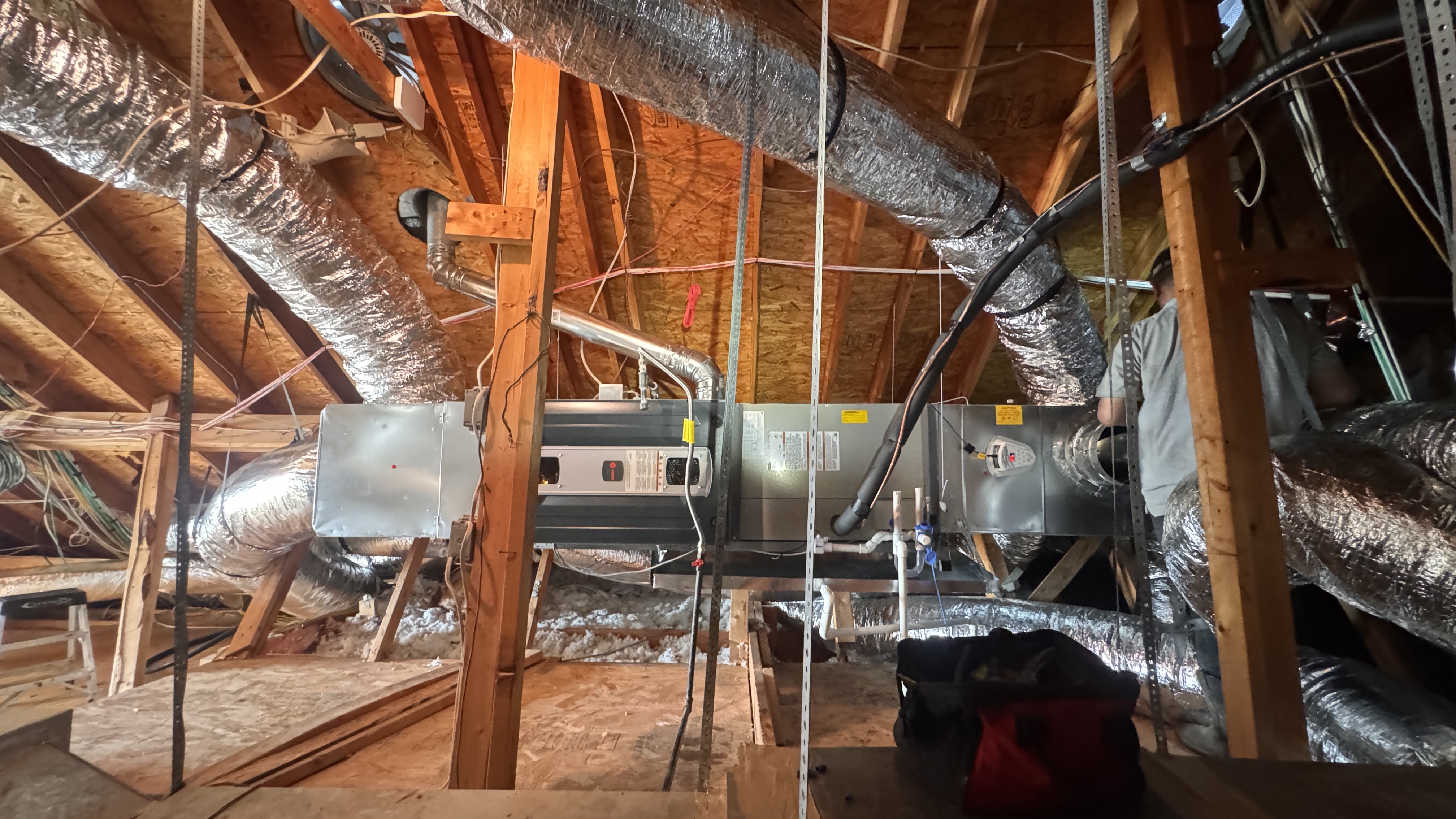
Premium HVAC equipment cannot deliver its full comfort or efficiency potential if airflow and ductwork are inadequate.
Bigger Is Not Better
Another common mistake is combining premium variable-speed equipment with improper sizing.
Homeowners sometimes think:
“If 4 tons is good, 5 tons will cool even better.”
Not necessarily.
An oversized system can satisfy the thermostat too quickly.
Carrier notes that oversized equipment can short-cycle and shut down before adequate dehumidification occurs.
Proper sizing should consider more than square footage.
Factors can include:
- Home size
- Ceiling height
- Windows
- Orientation
- Insulation
- Air leakage
- Duct location
- Local design conditions
- Internal heat loads
ACCA’s Manual J is the nationally recognized residential load-calculation procedure for determining heating and cooling loads.
🚨 Important: “Variable-Speed” Can Mean Two Different Things
This causes a lot of confusion.
A salesperson may say:
“This system has a variable-speed motor.”
That does not necessarily mean you are buying a variable-capacity AC.
Variable-Speed Indoor Blower
This refers to the blower motor inside the furnace or air handler.
It can adjust airflow.
Variable-Speed / Variable-Capacity Compressor
This refers to the compressor in the outdoor AC or heat pump.
It adjusts actual refrigeration capacity.
DON’T CONFUSE THESE
| Variable-Speed Blower | Variable-Capacity Compressor |
|---|---|
| Located indoors | Located outdoors |
| Controls airflow | Controls cooling capacity |
| Part of furnace/air handler | Part of AC/heat pump |
| Can be paired with staged equipment | Defines outdoor-system modulation |
| Does not automatically make AC variable-capacity | Actually changes compressor output |
Ask specifically:
“Is the outdoor compressor single-stage, two-stage, multi-stage or variable-capacity?”
That’s much clearer than simply asking whether the system is “variable-speed.”
What Is an Inverter AC?
Variable-capacity residential HVAC equipment commonly uses inverter-driven compressor technology.
Rather than operating the compressor motor at only one fixed output, the inverter allows the system to change compressor operation according to demand.
That’s why you’ll often see terms such as:
Variable-speed
Variable-capacity
Inverter
used when discussing premium modulating HVAC equipment.
The exact implementation differs by manufacturer.
Do Variable-Speed Systems Run All Day?
They can run for long periods—and that is not necessarily a problem.
The goal is not always to shut the AC off as quickly as possible.
At low cooling demand, a variable-capacity system may operate gently for long periods while:
🌡️ Maintaining temperature
💧 Removing humidity
🌬️ Circulating air
🔇 Operating quietly
A long runtime at reduced capacity is fundamentally different from a single-stage AC running continuously at 100% because it cannot satisfy the thermostat.
Does Variable-Speed Mean Higher Repair Costs?
Potentially.
Variable-capacity equipment uses more sophisticated components and controls than basic single-stage equipment.
Depending on the system, this may include:
- Inverter electronics
- Communicating controls
- Specialized compressor technology
- Sensors
- Manufacturer-specific control boards
This is worth considering when comparing long-term ownership.
Single-stage
Simpler equipment can be attractive for homeowners who value lower complexity and potentially simpler repairs.
Variable-speed
You’re paying for more advanced control, efficiency and comfort—but you’re also purchasing more sophisticated technology.
Neither approach is automatically wrong.
Does a Variable-Speed AC Need a Special Thermostat?
It depends on the system.
Some variable-capacity equipment is designed to work with a manufacturer-specific communicating control so the indoor and outdoor equipment can exchange operating information.
Other systems may support different control arrangements.
Before purchasing, verify:
- Required thermostat/control
- Wi-Fi functionality
- Communicating requirements
- Replacement-control cost
- Compatibility with existing zoning
- Compatibility with indoor equipment
Don’t assume your existing thermostat can control every feature of a premium system.
Single-Stage vs. Two-Stage vs. Variable-Speed: Comfort Contrast
| Category | Single | Two-Stage | Variable |
|---|---|---|---|
| Upfront affordability | ⭐⭐⭐⭐⭐ | ⭐⭐⭐ | ⭐⭐ |
| Temperature consistency | ⭐⭐⭐ | ⭐⭐⭐⭐ | ⭐⭐⭐⭐⭐ |
| Humidity control | ⭐⭐⭐ | ⭐⭐⭐⭐ | ⭐⭐⭐⭐⭐ |
| Quiet operation | ⭐⭐⭐ | ⭐⭐⭐⭐ | ⭐⭐⭐⭐⭐ |
| Technology simplicity | ⭐⭐⭐⭐⭐ | ⭐⭐⭐⭐ | ⭐⭐ |
| Efficiency potential | ⭐⭐⭐ | ⭐⭐⭐⭐ | ⭐⭐⭐⭐⭐ |
| Premium comfort | ⭐⭐⭐ | ⭐⭐⭐⭐ | ⭐⭐⭐⭐⭐ |
These ratings are intended as a general comparison, not a performance rating for a specific model.
Actual performance depends on the equipment combination and installation.
What Matters More Than the Number of Stages?
The answer may surprise you:
Installation quality.
A premium variable-speed AC that is:
❌ Oversized
❌ Improperly charged
❌ Connected to undersized ductwork
❌ Operating against excessive static pressure
❌ Poorly commissioned
may perform worse than a properly selected and installed two-stage or even single-stage system.
Carrier explicitly emphasizes proper sizing, airflow, ductwork inspection and refrigerant charging when selecting advanced HVAC equipment.
Before Buying, Compare These 8 Things
Don’t compare equipment only by tonnage and price.
1. Compressor technology
Single-stage, two-stage or variable-capacity?
2. SEER2
What is the matched-system seasonal efficiency?
3. EER2
How efficiently does the system perform under high-temperature test conditions?
4. Indoor blower
PSC, constant-torque ECM or variable-speed ECM?
5. Sound rating
Especially important near bedrooms and patios.
6. Thermostat/control requirements
Standard or communicating?
7. Warranty
Parts, compressor and labor coverage can differ.
8. Installation
Who is installing it and what exactly is included?
🏆 So Which AC Is Best for a Texas Home?
There isn’t one answer for every homeowner.
Choose SINGLE-STAGE if:
💰 Your priority is the lowest initial investment.
You want straightforward equipment and don’t need premium comfort features.
Choose TWO-STAGE if:
⚖️ You want a strong balance between purchase price, efficiency, humidity control and comfort.
For many Texas homeowners, two-stage equipment can be a very sensible upgrade.
Choose VARIABLE-SPEED if:
🏆 You want the highest level of temperature control, humidity management, quiet operation and efficiency potential—and are comfortable paying more for it.
Our Recommendation for Texas Homeowners
Don’t begin the conversation with:
“Do I need variable-speed?”
Start with:
“What does my home actually need?”
Then compare equipment that correctly meets those requirements.
The correct order is:
1. Determine cooling load
↓
2. Evaluate ductwork and airflow
↓
3. Select proper capacity
↓
4. Compare efficiency
↓
5. Choose the comfort level
↓
6. Compare total installed price
That’s a much better approach than buying the highest SEER2 or most expensive compressor simply because it sounds better.
📷 IMAGE 4 — Texas Home Comfort
Recommended image: Modern Texas home with outdoor condenser, subtly showing cool conditioned interior and intense summer conditions outside.
Caption:
The best AC system is the one properly sized, matched and installed for your home’s actual cooling requirements.
Alt text:
High efficiency residential air conditioner cooling Texas home
Frequently Asked Questions
Is two-stage AC worth it in Texas?
For many homeowners, yes. A two-stage system can provide longer low-capacity cooling cycles, better temperature consistency, quieter operation and improved humidity control compared with basic single-stage equipment.
Is variable-speed AC worth the extra money?
It can be if premium comfort, humidity control, lower sound and higher efficiency potential are important to you and you plan to own the home long enough to benefit from the upgrade.
If lowest purchase price is your priority, it may not be necessary.
Is variable-speed AC more efficient?
Variable-capacity equipment generally offers the highest efficiency potential because output can more closely match cooling demand. However, always compare the specific equipment’s SEER2 and EER2 ratings rather than judging efficiency from compressor technology alone.
Does a two-stage AC run on low stage most of the time?
A properly designed two-stage system can spend substantial time on low stage during moderate cooling conditions and shift to high stage as demand increases. The exact operation depends on equipment, thermostat/control strategy, home load and outdoor conditions.
Does variable-speed AC run continuously?
It may run for long periods at reduced capacity. This can be normal and may improve temperature stability and humidity removal.
Which AC is most reliable?
Reliability depends on much more than staging. Equipment quality, installation, electrical conditions, airflow, maintenance and operating conditions all matter.
Single-stage systems are generally simpler. Variable-capacity systems provide more advanced comfort but use more sophisticated electronics and controls.
Does variable-speed mean variable-speed blower?
Not necessarily. A variable-speed indoor blower controls airflow, while a variable-capacity outdoor compressor controls cooling capacity. Always verify which component is actually variable.
Is a bigger variable-speed AC better?
No. Variable capacity does not eliminate the need for proper equipment sizing. ACCA Manual J is the recognized residential procedure for determining the home’s heating and cooling loads.
Should I choose SEER2 or compressor stages first?
Look at the complete system. Compressor technology affects comfort, while SEER2 and EER2 indicate efficiency. Proper sizing, airflow and installation should come before either.
Shopping for a New AC in Texas?
NewACShop makes it easier to compare professionally installed HVAC systems by:
❄️ Cooling capacity
⚡ Efficiency
⚙️ Compressor technology
🏠 Equipment configuration
💰 Installed price
Whether you’re looking for an affordable single-stage system, a two-stage comfort upgrade or premium variable-capacity equipment, compare the complete HVAC system—not just the outdoor-unit model number.
Find the right AC system for your Texas home and compare your replacement options before you buy.
