
If you’re shopping for a new air conditioner in Texas in 2026, you may notice something different on the equipment specifications: instead of the familiar R-410A refrigerant, many new HVAC systems now use R-454B or another lower-GWP refrigerant such as R-32.
This change has created plenty of questions for homeowners.
Is R-410A being banned? Is R-454B safe? Is one refrigerant better than the other? Can an existing R-410A system still be repaired? And if you’re replacing your AC this year, should you specifically look for an R-454B system?
Here is what Texas homeowners should know before making a decision.
What Changed With HVAC Refrigerants?
For many years, R-410A was the standard refrigerant used in residential air conditioners and heat pumps.
The problem is not ozone depletion. R-410A has zero ozone depletion potential. Instead, the concern is its relatively high Global Warming Potential, or GWP.
R-410A has a GWP of approximately 2,088, while R-454B has a GWP of approximately 466 — about 78% lower.
Federal regulations under the American Innovation and Manufacturing Act established a 700-GWP limit for newly manufactured or imported residential and light-commercial air-conditioning and heat-pump equipment. This is why manufacturers have transitioned toward refrigerants such as R-454B and R-32.
That does not mean every R-410A air conditioner suddenly became obsolete.
What Is R-454B?
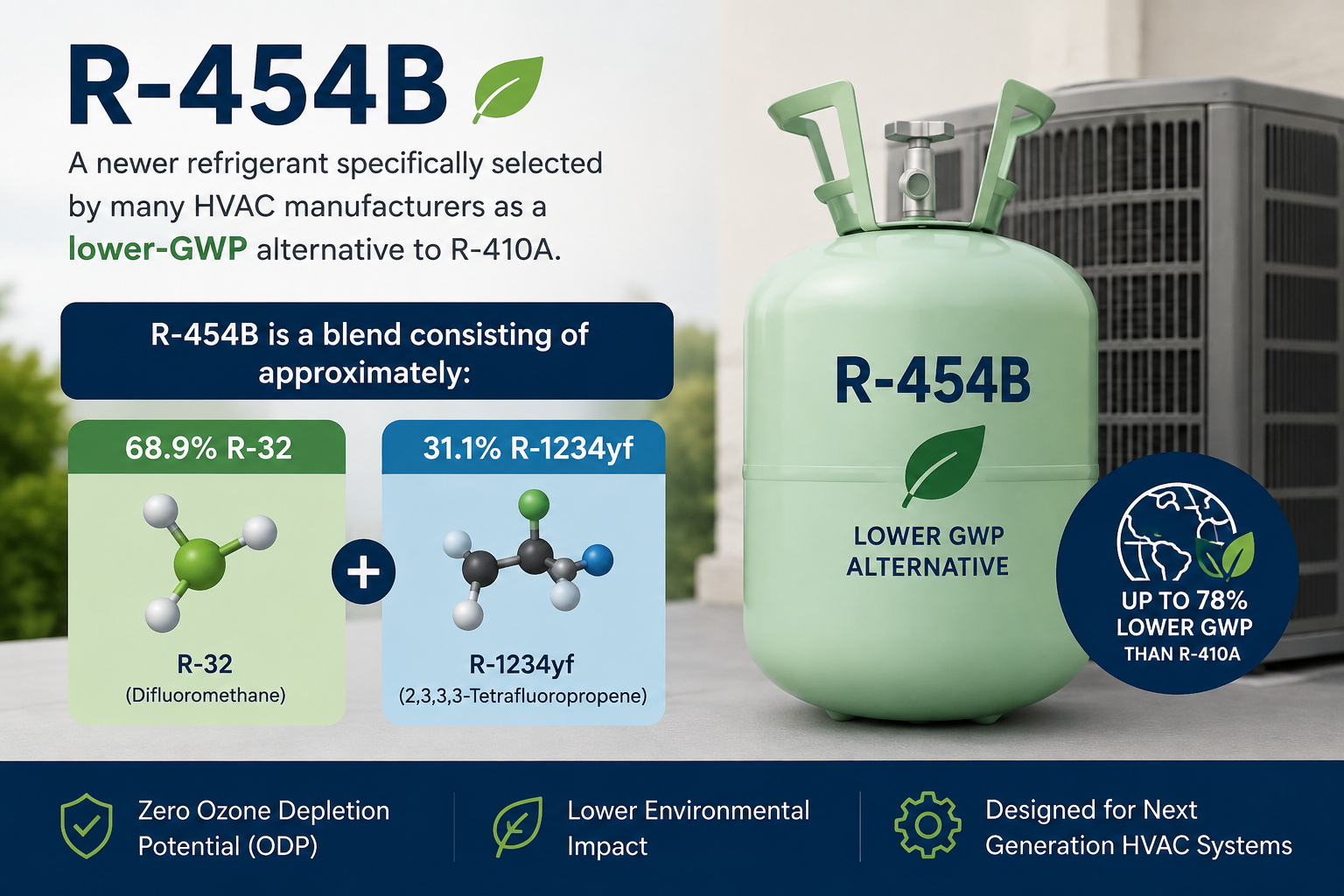
- 68.9% R-32
- 31.1% R-1234yf
ASHRAE classifies R-454B as an A2L refrigerant, meaning it has lower toxicity and lower flammability characteristics than refrigerants in higher flammability classifications.
Major manufacturers have already introduced residential air conditioners and heat pumps designed around R-454B. For example, Trane reports that most of its residential products transitioned to R-454B, while some products use R-32.
R-454B vs. R-410A at a Glance
| Feature | R-410A | R-454B |
|---|---|---|
| GWP | Approx. 2,088 | Approx. 466 |
| Ozone Depletion Potential | 0 | 0 |
| ASHRAE Safety Classification | A1 | A2L |
| Used in Existing Systems | Very common | Growing rapidly |
| Used in Newly Manufactured Residential Equipment | Primarily legacy/service applications | Common in new equipment |
| Can Be Mixed With the Other Refrigerant? | No | No |
| Can R-454B Be Added to an R-410A System? | — | No |
R-454B’s much lower GWP is the primary reason for the transition. The refrigerant itself, however, should not be used as the only way to judge the quality or efficiency of an HVAC system.
Is R-410A Banned in 2026?
No.
This is probably the biggest misconception surrounding the refrigerant transition.
Existing R-410A air conditioners and heat pumps can continue to operate and be serviced. EPA regulations allow R-410A components to continue being manufactured and sold for servicing existing equipment.
There was originally also a January 1, 2026 deadline affecting installation of remaining R-410A residential equipment. However, EPA changed this requirement in May 2026.
Under the current rule, R-410A residential and light-commercial equipment that was manufactured in the United States or imported into the United States before January 1, 2025 may still be installed as part of a new system. EPA removed the installation deadline for this remaining legacy inventory.
There is an important distinction, however.
New R-410A equipment manufactured or imported after January 1, 2025 cannot be used to create a new residential R-410A system. Equipment produced after that date for R-410A applications is generally intended for servicing existing systems.
So R-410A is not disappearing overnight, but the residential HVAC industry is clearly moving toward lower-GWP refrigerants.
Should I Replace My Existing R-410A AC Because of the Refrigerant Change?
Usually, no.
If your existing R-410A system is reliable, properly sized, efficient enough for your home, and in good mechanical condition, there is no reason to replace it simply because the industry is transitioning to another refrigerant.
R-410A systems can continue to be repaired and replacement components can still be supplied for legacy equipment.
The decision to replace an air conditioner should normally be based on factors such as:
- Equipment age
- Compressor or coil condition
- Frequency of repairs
- Refrigerant leaks
- Energy consumption
- Comfort problems
- System efficiency
- Cost of the repair compared with replacement
- Overall condition of the indoor and outdoor equipment

Refrigerant type is another factor to consider, but it shouldn’t automatically determine whether a working system needs replacement.
Can R-454B Be Put Into an Existing R-410A System?
No.
R-454B is not a drop-in replacement for R-410A.
An R-410A air conditioner was not engineered or safety-certified to operate with R-454B. EPA guidance specifically notes that mildly flammable refrigerants such as R-454B or R-32 should not be used in systems that were not designed for them.
Changing refrigerant involves more than simply recovering one refrigerant and charging another.
R-454B equipment is designed around the refrigerant’s operating characteristics and A2L safety requirements. Depending on the equipment and installation, additional refrigerant detection or mitigation features may also be required.
If you own an R-410A system, it should continue using the refrigerant for which it was designed.
Is R-454B Safe?
This is another common concern because R-454B carries an A2L classification, while R-410A is classified A1.
The “A” represents lower toxicity, while “2L” identifies a refrigerant with lower flammability characteristics and a relatively low burning velocity. ASHRAE specifically classifies R-454B as A2L.
That does not mean contractors can treat R-454B exactly like R-410A.
Equipment, installation procedures, tools and service practices must be appropriate for A2L refrigerants. Residential refrigeration safety standards have also been updated to accommodate A2L refrigerants.
For homeowners, the practical takeaway is simple:
R-454B should be used only in equipment specifically designed for R-454B and installed according to manufacturer requirements and applicable mechanical codes.
Is R-454B More Efficient Than R-410A?
Not automatically.
Refrigerant is only one part of an HVAC system.
The efficiency of your air conditioner depends on the entire equipment design, including the compressor, condenser coil, evaporator coil, blower, metering device, controls and system configuration.
Manufacturers can design highly efficient equipment around R-454B, and some manufacturers report efficiency advantages when optimizing equipment for the refrigerant.
But homeowners should compare the actual SEER2 rating, system performance and equipment features rather than assuming that an R-454B system is automatically more efficient simply because it uses a newer refrigerant.
For a Texas home with a long cooling season, the difference between a basic single-stage system and a properly designed higher-efficiency or variable-capacity system can matter much more than the refrigerant name printed on the data plate.
Will R-410A Refrigerant Still Be Available?
R-410A can still be used to service existing systems, and EPA regulations specifically allow components for legacy R-410A equipment to remain available.
However, the United States is gradually reducing overall HFC production and consumption under the AIM Act.
For that reason, homeowners with older R-410A equipment should understand that refrigerant availability and pricing could become less predictable over the long term.
That doesn’t mean an R-410A system needs immediate replacement. But if you’re comparing an expensive repair on an older R-410A system against purchasing a completely new system, the refrigerant transition is reasonable to include in the decision.
Should You Buy an R-410A System in 2026?
This requires a little more consideration.
Because EPA now permits remaining pre-2025 R-410A inventory to be installed, homeowners may still encounter legitimate new R-410A equipment for sale in 2026.
That doesn’t automatically make it a bad purchase.
A heavily discounted R-410A system from a reputable manufacturer could make financial sense in certain situations, particularly when the homeowner expects to keep the property for a limited period or when the price difference is substantial.
However, if prices are relatively close, we would generally favor a current-generation R-454B or R-32 system for a complete HVAC replacement.
Why?
Because you’re purchasing equipment that may remain in service for many years. Choosing the current refrigerant platform gives you a system designed around the refrigerants manufacturers are supporting for their newest product generations.
R-454B or R-32: Which One Is Better?
R-454B isn’t the only new refrigerant being used in residential HVAC.
R-32 also meets the federal requirement with a GWP of approximately 675, compared with approximately 466 for R-454B and 2,088 for R-410A.
Some manufacturers selected R-454B while others use R-32 for certain product lines.
For most homeowners, this should not be the deciding factor between two good HVAC systems.
Instead, compare:
- Manufacturer and equipment quality
- SEER2 efficiency
- Single-stage, multi-stage or variable-speed operation
- Compressor technology
- Indoor blower performance
- Warranty
- Installation quality
- Contractor support
- Replacement-part availability
- Total installed price
A properly selected and installed system matters far more than choosing equipment solely because one refrigerant has a particular name.
What Matters Most for a Texas Home?
Texas air conditioners operate under demanding conditions.
During the summer, an AC system may run for many hours every day. That makes proper system selection and installation especially important.
When shopping for a replacement system, focus on the complete HVAC package rather than refrigerant alone.
1. Proper System Size
Bigger isn’t automatically better.
An oversized system can cool quickly but may short-cycle and provide poor humidity control. An undersized system may struggle to maintain temperature during extreme heat.
2. SEER2 Efficiency
Higher efficiency can reduce electricity consumption, but the best efficiency level depends on equipment cost, how long you expect to own the home and how heavily the system operates.
3. Compressor Technology
Single-stage, two-stage and variable-speed systems provide very different comfort and operating characteristics.
4. Indoor Airflow and Ductwork
Even premium equipment will perform poorly with undersized returns, damaged ducts, incorrect blower settings or major airflow restrictions.
5. Installation Quality
Proper evacuation, refrigerant charging, airflow adjustment, condensate drainage, electrical installation and system commissioning can have a major effect on reliability and performance.
The refrigerant is important — but the quality of the entire HVAC system and installation is more important.
The Bottom Line: R-454B vs. R-410A in 2026
If you already own an R-410A system that is working properly, there is no reason to replace it just because of the refrigerant transition.
If it needs a repair, R-410A systems can still be serviced.
If you’re purchasing an entirely new HVAC system in 2026, however, R-454B and R-32 equipment represent the direction of new residential HVAC manufacturing because they meet the federal 700-GWP requirement.
And while some remaining pre-2025 R-410A equipment can legally still be installed, homeowners should compare the discount against the long-term advantages of purchasing a current-generation system.
Most importantly, don’t choose an air conditioner based on refrigerant alone.
Equipment quality, proper sizing, efficiency, system design and professional installation will have a much greater impact on how well your AC performs during a Texas summer.
Shopping for a New AC in Texas?
NewACShop makes it easier to compare new HVAC systems, equipment options and professionally installed AC replacement packages.
Whether you’re replacing an older R-410A system or upgrading to a new R-454B system, compare the complete system — not just the refrigerant.
Shop new AC systems and find the right combination of equipment, efficiency and price for your home.
Frequently Asked Questions
Is R-410A illegal in 2026?
No. Existing R-410A systems can continue operating and being repaired. In addition, under EPA’s May 2026 rule, qualifying R-410A equipment manufactured or imported before January 1, 2025 may still be installed from remaining inventory.
Can I recharge my existing R-410A air conditioner?
Yes. R-410A can still be used when servicing equipment designed for R-410A.
Can R-454B replace R-410A in my existing AC?
No. R-454B should not be installed into equipment designed for R-410A. The system must be specifically engineered for the refrigerant.
Is R-454B flammable?
R-454B is classified by ASHRAE as A2L, which is a lower-flammability refrigerant classification. Systems using R-454B must be designed and installed according to requirements applicable to A2L refrigerants.
Does R-454B cool better than R-410A?
Not simply because of the refrigerant. Cooling performance depends on the design and efficiency of the entire HVAC system.
Should I choose R-454B or R-410A for a new system?
If two comparable systems are similarly priced, a current-generation R-454B system will generally make more sense for a long-term replacement. Discounted qualifying R-410A inventory can still be worth considering, but price, warranty, efficiency, equipment quality and expected ownership period should all be evaluated.
Will I still be able to repair an R-410A AC in the future?
Yes. EPA rules allow R-410A components to continue being manufactured and sold for servicing existing systems.
