
When replacing an air conditioner in Texas, one of the first numbers you’ll see is the SEER2 rating.
You may find systems advertised as:
- ❄️ 14 SEER2
- ⚡ 16 SEER2
- 🌿 18 SEER2
- 🏆 20+ SEER2
The higher number sounds better—but does it make financial sense to pay more for it?
For some Texas homeowners, absolutely.
For others, a reliable 14 or 16 SEER2 system may provide a much better return on the initial investment.
The answer depends on more than the efficiency label. Your electricity usage, equipment technology, home insulation, ductwork, system size, comfort expectations, installation quality, and how long you plan to own the house all matter.
Let’s compare the options.
⚡ 1. What Does SEER2 Actually Mean?
SEER2 stands for:
Seasonal Energy Efficiency Ratio 2
It measures the seasonal cooling efficiency of an air conditioner or heat pump.
In simple terms:
Higher SEER2 = less electricity required to provide the same amount of seasonal cooling.
Think about two cars traveling the same distance.
One gets 20 MPG.
The other gets 30 MPG.
Both get you to the same destination, but one requires less fuel.
SEER2 works in a similar way for your air conditioner.
SEER vs. SEER2
You may still see older air conditioners described as:
14 SEER
16 SEER
18 SEER
Newer equipment is rated using the updated SEER2 testing procedure.
SEER and SEER2 aren’t directly interchangeable numbers because the newer testing procedure better represents the external static pressure an installed HVAC system encounters.
When shopping for a new system today, compare:
SEER2 to SEER2
rather than comparing an older SEER number directly with a newer SEER2 number.
📊 2. 14 vs. 16 vs. 18+ SEER2 at a Glance
| Feature | 14 SEER2 | 16 SEER2 | 18+ SEER2 |
|---|---|---|---|
| Initial equipment cost | $ | $$ | $$$ |
| Seasonal efficiency | Good | Better | Highest |
| Electricity-saving potential | Standard | Moderate | Highest |
| Compressor technology | Often single-stage | Single or staged, depending on model | Often staged or variable-capacity |
| Temperature consistency | Good | Good to very good | Excellent with variable capacity |
| Humidity control | Standard | Better with proper staging | Usually best with variable capacity |
| Sound | Standard | Often quieter | Usually quietest at lower capacity |
| Technology complexity | Lower | Moderate | Higher |
| Best fit | Budget/value | Efficiency/value balance | Premium comfort & efficiency |
These are general comparisons.
SEER2 alone does not tell you whether an AC is single-stage, two-stage, or variable-speed. Always check the actual equipment specifications.
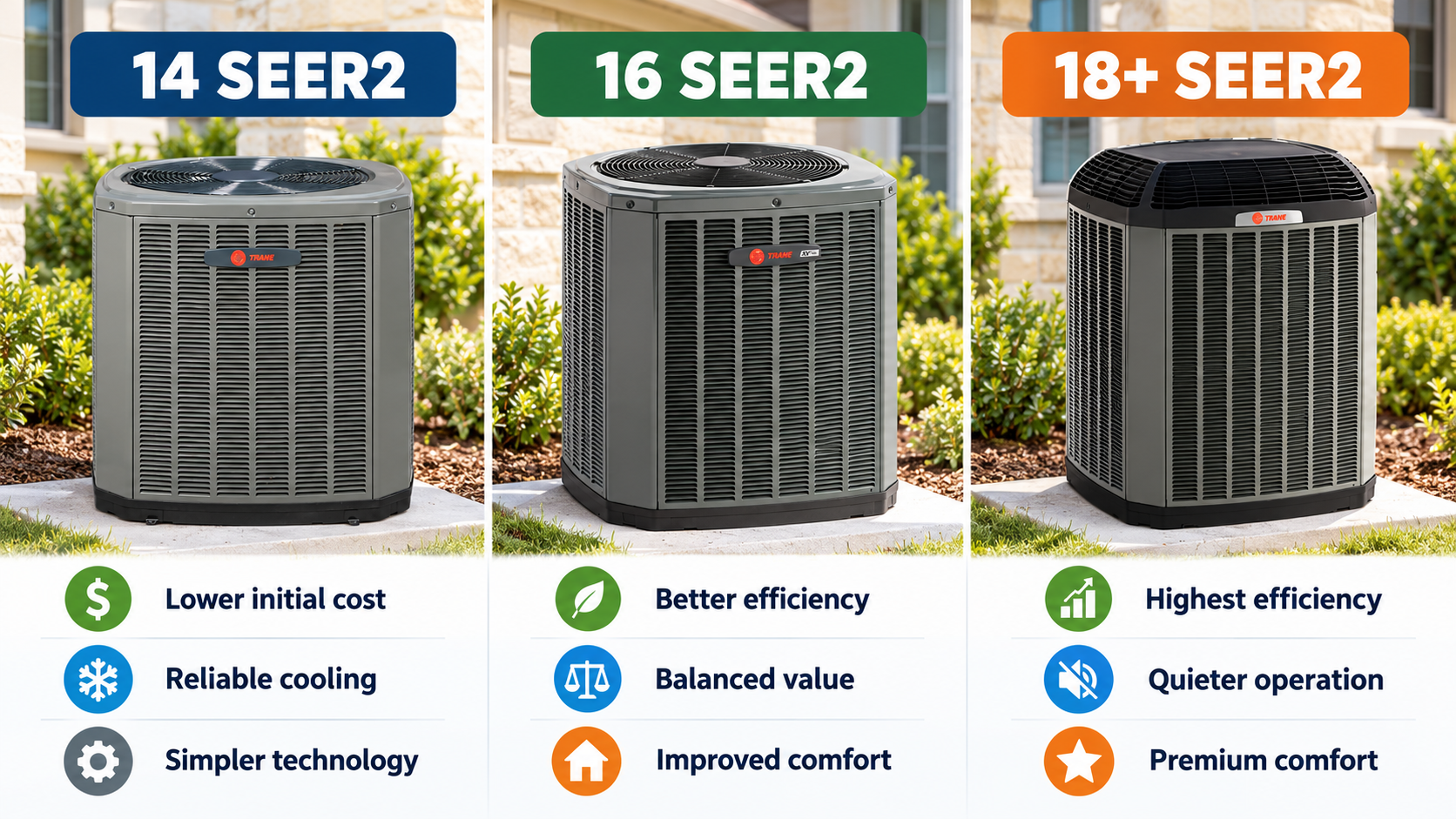
Caption:
Higher-SEER2 air conditioners can provide greater seasonal energy efficiency, but equipment technology and installation quality also affect comfort and operating cost.
💡 3. How Much More Efficient Is 16 SEER2 Than 14 SEER2?
For the same amount of cooling, electricity consumption is approximately inversely related to the SEER2 rating.
That means moving from 14 to 16 SEER2 does not mean:
“16 is 14% more efficient, so my electric bill will drop 14%.”
The calculation is slightly different.
Approximate cooling-energy reduction:
| Upgrade | Approximate Reduction in Cooling Electricity* |
|---|---|
| 14 → 16 SEER2 | 12.5% |
| 14 → 18 SEER2 | 22.2% |
| 14 → 20 SEER2 | 30% |
| 16 → 18 SEER2 | 11.1% |
| 16 → 20 SEER2 | 20% |
| 18 → 20 SEER2 | 10% |
*Theoretical comparison assuming equal cooling load and comparable operating conditions. Actual household savings vary.
This is an important distinction.
Going from 14 to 16 provides a meaningful efficiency improvement.
Going from 16 to 18 provides another improvement—but the incremental savings become smaller.
💰 4. What Could That Mean for Your Electric Bill?
Let’s use a simple example.
Suppose a 14 SEER2 system would use approximately $1,000 per year in electricity specifically for cooling.
Under equivalent conditions:
| System | Illustrative Annual Cooling Cost | Approximate Savings vs. 14 SEER2 |
|---|---|---|
| 14 SEER2 | $1,000 | — |
| 16 SEER2 | $875 | $125/year |
| 18 SEER2 | $778 | $222/year |
| 20 SEER2 | $700 | $300/year |
Important:
This is an illustration, not a prediction of your utility bill.
Your actual cost depends on:
- Home size
- Equipment tonnage
- Thermostat setting
- Weather
- Electricity rate
- Insulation
- Windows
- Duct leakage
- System runtime
- Indoor humidity
- Equipment sizing
- Installation quality
And remember—your electric bill includes much more than your air conditioner.
Lighting, appliances, pool equipment, water heating, electronics, and other electrical loads won’t become more efficient simply because you install a higher-SEER2 AC.
🔵 5. 14 SEER2: The Value Option
A 14-SEER2-class system is generally positioned toward the value end of today’s HVAC market.
These systems commonly use straightforward compressor technology and focus on:
🔧 Reliability
💰 Lower initial investment
❄️ Effective cooling
🛠️ Simpler serviceability
For many homeowners, that’s exactly what they need.
✅ Advantages of 14 SEER2
Lower purchase price
This is usually the biggest advantage.
If your priority is replacing a failed system without making a major investment in premium features, a basic system can make good financial sense.
Simpler technology
Many systems in this category use conventional single-stage compressors and straightforward controls.
Good cooling performance
A properly sized and installed 14 SEER2 system can cool a Texas home perfectly well.
Good option for rentals
Premium efficiency doesn’t always generate enough return in a rental property to justify a large equipment-price increase.
❌ Disadvantages of 14 SEER2
Higher electricity consumption
Compared with a higher-efficiency system providing the same amount of cooling, it will generally consume more electricity.
Full-capacity operation
Many basic systems are single-stage:
100% ON → OFF → 100% ON → OFF
That can create larger indoor temperature swings than a modulating system.
Basic humidity control
A correctly sized single-stage system can manage humidity effectively, but staged and variable-capacity equipment can usually provide more precise control.
🟢 6. 16 SEER2: The Sweet Spot?
For many Texas homeowners, the middle efficiency range deserves serious consideration.
A 16 SEER2 system can provide a noticeable efficiency improvement over basic equipment without necessarily carrying the price premium of an 18–20+ SEER2 system.
✅ Advantages
⚡ Lower seasonal electricity consumption than 14 SEER2
💰 Moderate equipment-price premium
🏠 Good option for a long-term primary residence
🌡️ Potential for improved comfort depending on compressor and blower technology
📈 Better efficiency without automatically moving into premium equipment
Why 16 SEER2 Can Make Sense in Texas
In a climate with a long cooling season, relatively small efficiency improvements have more opportunities to generate savings.
A homeowner in a mild climate may use the AC heavily for only part of the year.
A Texas homeowner may run the cooling system for many months.
That means the efficiency difference has more operating hours in which to matter.
⚠️ But Don’t Buy Based on SEER2 Alone
Two 16 SEER2 systems may operate very differently.
One could be:
Single-stage
while another could incorporate:
Multi-stage or more advanced equipment
depending on the manufacturer and matched system.
Always compare the actual equipment—not just the SEER2 number.
🏆 7. 18+ SEER2: Premium Efficiency
Once you move into approximately 18 SEER2 and above, you’re often looking at premium HVAC systems.
Depending on the manufacturer, these systems may incorporate:
- Multi-stage compressors
- Variable-capacity compressors
- Inverter technology
- Variable-speed indoor blowers
- Communicating controls
- Advanced humidity management
- Quieter low-capacity operation
The efficiency rating matters, but many homeowners purchase these systems just as much for comfort as for electricity savings.
✅ Advantages of 18+ SEER2
⚡ Lower electricity consumption
Higher efficiency means less electrical energy is needed for the same seasonal cooling load.
🌡️ Better temperature consistency
Variable-capacity systems can adjust cooling output rather than constantly cycling between full output and off.
💧 Better humidity control
Longer operation at reduced capacity gives the evaporator coil more time to remove moisture from indoor air.
🔇 Quieter operation
A variable-capacity condenser operating at 30–50% output can be much less noticeable than a single-stage condenser starting at full capacity.
🛋️ Premium comfort
The house can maintain a much tighter temperature range with less noticeable cycling.
❌ Disadvantages of 18+ SEER2
💰 Higher initial price
Premium technology costs more.
🔧 Greater complexity
Inverter boards, sensors, communicating controls, variable-capacity compressors, and specialized electronics add sophistication to the system.
💵 Potentially higher repair costs
Premium components can cost more to replace once warranty coverage ends.
⏳ Longer financial payback
Electricity savings alone may take many years to recover a large purchase-price difference.
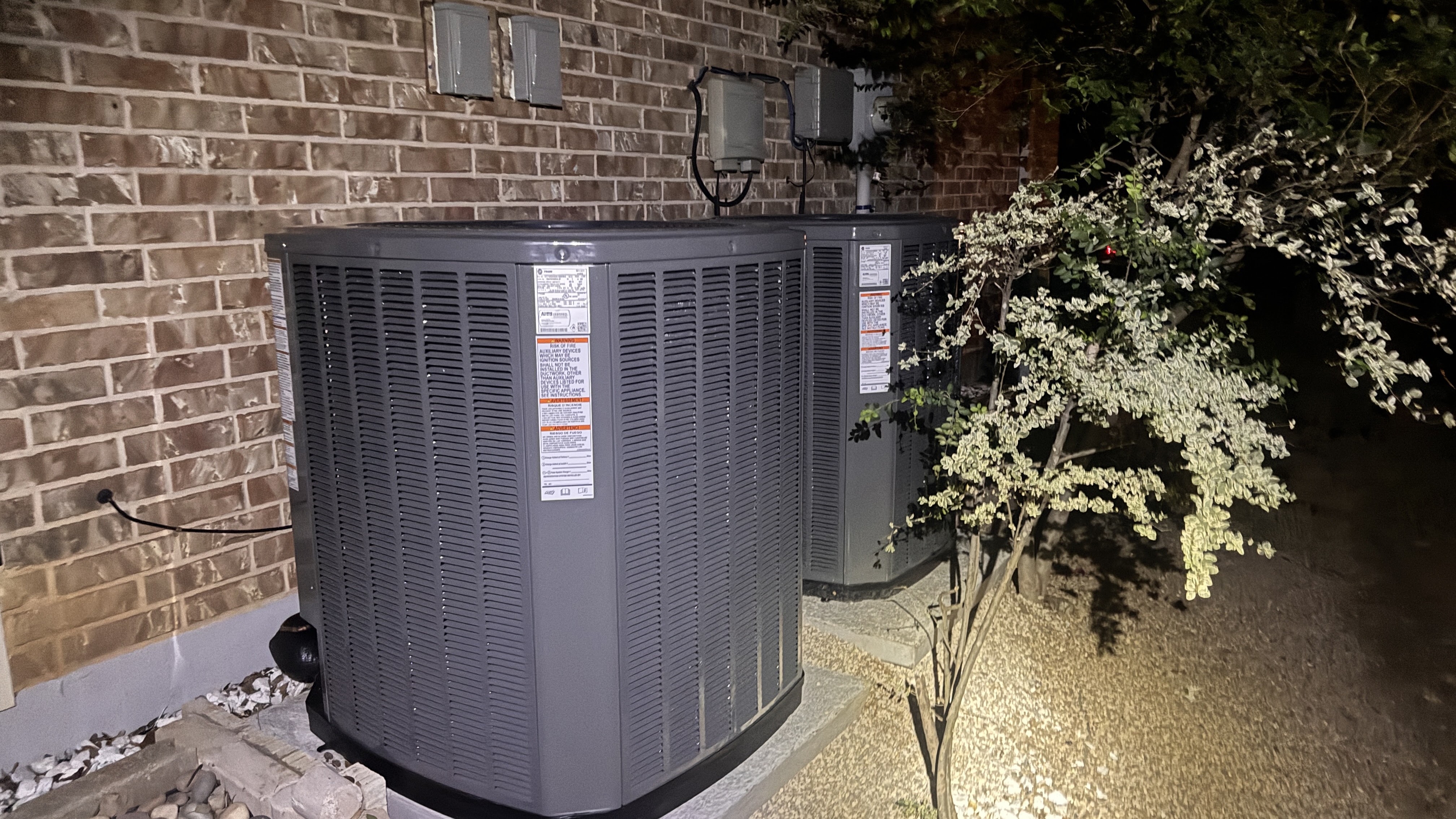
Caption:
Many premium 18+ SEER2 systems combine high seasonal efficiency with variable-capacity operation for quieter performance and more consistent indoor comfort.
🌡️ 8. Is High-Efficiency AC More Valuable in Texas?
Generally, Texas is one of the places where AC efficiency deserves serious consideration.
Why?
Because cooling demand is high.
During a North Texas summer, residential systems may operate for many hours per day.
More runtime means more opportunity for an efficient system to reduce electricity consumption.
But that doesn’t automatically mean everyone should buy the highest-SEER2 model available.
💵 9. How Do You Calculate Whether the Upgrade Is Worth It?
Instead of asking:
“Is 18 SEER2 better than 14?”
Ask:
“How much extra does the 18 SEER2 system cost, and how much should I realistically save?”
A simple payback calculation is:
Additional Installed Cost ÷ Estimated Annual Energy Savings = Simple Payback
Example
Suppose:
14 SEER2 installed price: $10,000
18 SEER2 installed price: $13,000
Price difference: $3,000
Estimated cooling savings:
$250 per year
Then:
$3,000 ÷ $250 = 12 years
In that example, the simple energy-only payback is approximately 12 years.
But that doesn’t automatically mean the upgrade is a bad decision.
The homeowner may also value:
🌡️ Better temperature control
💧 Better humidity management
🔇 Quieter operation
⚡ Reduced peak electricity consumption
🛋️ Premium comfort
Efficiency is only one part of the value.
⚖️ 10. Don’t Confuse Efficiency With Comfort
This is one of the biggest mistakes when comparing HVAC systems.
SEER2 measures efficiency.
It doesn’t directly measure:
- Noise
- Humidity control
- Temperature stability
- Airflow quality
- Compressor staging
- Reliability
- Repair cost
- Equipment life
A system can have a higher SEER2 rating without automatically being the best choice for every homeowner.
🔄 11. Single-Stage vs. Two-Stage vs. Variable-Speed
SEER2 and compressor technology are related—but they are not the same thing.
Single-Stage
The compressor operates:
100% or OFF
Simple and economical.
Two-Stage / Multi-Stage
The compressor can operate at more than one capacity.
For example:
LOW → HIGH
This allows the system to better match moderate and high cooling demand.
Variable-Capacity
An inverter-driven compressor can adjust over a much broader range.
Instead of:
OFF → 100%
it may operate more like:
35% → 47% → 62% → 78% → 100%
depending on equipment design and cooling demand.
Quick Comparison
| Feature | Single-Stage | Multi-Stage | Variable-Capacity |
|---|---|---|---|
| Cooling levels | 1 | 2 or more | Many |
| Temperature control | Good | Better | Best |
| Humidity control | Good | Better | Best |
| Noise | Standard | Lower at low stage | Usually lowest at reduced capacity |
| Complexity | Low | Medium | High |
| Typical equipment cost | $ | $$ | $$$ |
Important:
Do not assume every 16 SEER2 AC is two-stage or every 18 SEER2 AC is variable-speed.
Check the compressor specification.
💧 12. Why Humidity Control Matters
Texas comfort isn’t just about temperature.
Consider two homes:
Home A
74°F
45% relative humidity
Home B
74°F
65% relative humidity
They can feel dramatically different.
A system that operates for longer periods at reduced capacity may provide better moisture removal than an oversized single-stage system that rapidly cools the thermostat and shuts off.
This is one reason some homeowners choose variable-capacity equipment even when the electricity savings alone don’t provide a short financial payback.
🔇 13. High Efficiency Can Also Mean Quieter Operation
Outdoor condenser noise can matter if your AC is installed near:
🛏️ A bedroom window
🍽️ Outdoor dining area
🏊 Pool
🌳 Patio
🏘️ Neighboring property
Basic single-stage equipment starts at full operating capacity every time.
Variable-capacity equipment may spend much of its operating time at reduced output.
That can make the system considerably less noticeable.
If condenser noise matters to you, compare the manufacturer’s published sound rating—not just SEER2.
🌞 14. What About Performance on a 100°F Texas Day?
SEER2 is a seasonal efficiency rating.
It estimates performance over an entire cooling season.
But Texas homeowners also care about what happens during extreme summer conditions.
That’s where another rating becomes useful:
EER2
EER2 evaluates cooling efficiency at a specific operating condition rather than across an entire season.
When comparing equipment for a hot climate, it can be useful to look at:
SEER2 + EER2
rather than SEER2 alone.
A very high seasonal rating is attractive, but homeowners should still care about system performance when outdoor temperatures are high and the equipment is working hard.
🏠 15. Your Home Determines the Real Savings
Published efficiency ratings are measured under standardized conditions.
Your house isn’t a laboratory.
Real-world electricity consumption depends on the complete building and HVAC system.
Insulation
Poor attic insulation can dramatically increase cooling load.
Windows
Large west-facing windows can introduce substantial afternoon heat.
Air leakage
An inefficient building envelope allows hot outdoor air into the home.
Duct leakage
Cooling your attic instead of your rooms wastes energy.
Thermostat setting
Maintaining 68°F throughout a Texas summer requires substantially more cooling than maintaining 76°F.
Family habits
Doors opening, cooking, appliances, showers, and occupancy all affect cooling demand.
🌬️ 16. Ductwork Can Matter More Than the SEER2 Upgrade
Imagine spending thousands of dollars upgrading from 14 to 20 SEER2 while your attic duct system has:
❌ Disconnected ducts
❌ Major air leakage
❌ Crushed flex duct
❌ Undersized returns
❌ Excessive static pressure
The new equipment may have an excellent efficiency rating in a laboratory, but the overall HVAC system may still perform poorly in your house.
Fix major airflow problems first.
A properly installed 16 SEER2 system connected to correctly designed ductwork may provide better real-world results than premium equipment connected to a severely restricted duct system.
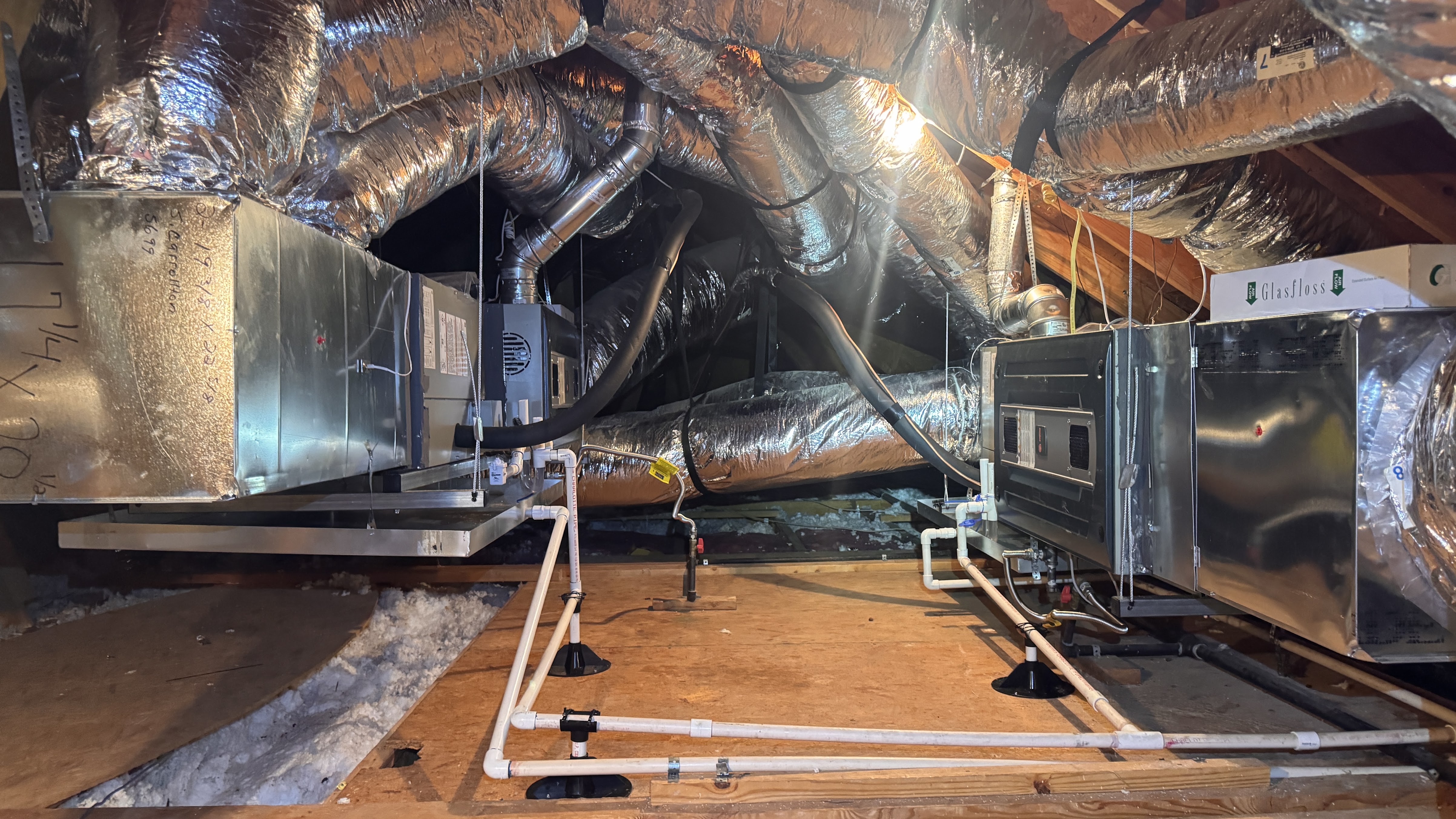
Caption:
The efficiency of the complete HVAC system depends on proper equipment selection, airflow, ductwork, refrigerant charge, and installation quality—not SEER2 alone.
📐 17. Proper AC Sizing Still Matters
Higher SEER2 doesn’t fix incorrect system sizing.
An oversized premium air conditioner may:
- Cool the house too quickly
- Short-cycle
- Provide poor humidity removal
- Create larger airflow problems
- Fail to deliver the comfort you expected
An undersized system may struggle during extreme weather.
Proper equipment selection should consider factors such as:
- Square footage
- Insulation
- Windows
- Ceiling height
- Orientation
- Air leakage
- Ductwork
- Internal heat loads
Bigger isn’t automatically better.
And higher SEER2 isn’t automatically better if the equipment isn’t properly sized.
🔧 18. Installation Quality Can Matter More Than 2 SEER2 Points
This deserves special attention.
Your new AC is a system, not just an outdoor condenser.
Installation quality can affect:
⚡ Efficiency
❄️ Cooling capacity
💧 Humidity removal
🔇 Noise
🛠️ Reliability
A good installation should address:
- Proper refrigerant line procedures
- Correct evacuation
- Proper refrigerant charge
- Correct airflow
- Filter drier
- Condensate drainage
- Electrical connections
- Equipment leveling
- Duct sealing
- Thermostat configuration
- System commissioning
Buying 20 SEER2 equipment doesn’t guarantee 20-SEER2-like real-world performance if the installation is poor.
💰 19. When Does 14 SEER2 Make the Most Sense?
A basic system can be a smart choice when:
✅ Lowest initial cost is important
✅ The home is a rental property
✅ You expect to sell relatively soon
✅ Your electricity usage is moderate
✅ You prefer simpler equipment
✅ Premium comfort isn’t a priority
Best description:
Good cooling at the lowest practical equipment investment.
⚡ 20. When Does 16 SEER2 Make the Most Sense?
A mid-efficiency system may be attractive when:
✅ This is your primary residence
✅ You plan to stay several years
✅ You use AC heavily
✅ You want lower operating costs
✅ You want a reasonable balance between purchase price and efficiency
Best description:
Strong balance of initial cost and operating efficiency.
🏆 21. When Does 18+ SEER2 Make the Most Sense?
Premium equipment deserves consideration when:
✅ You plan to own the home long-term
✅ Comfort is a priority
✅ You want better humidity control
✅ Quiet operation matters
✅ Your annual cooling usage is high
✅ You value variable-capacity technology
✅ You’re comfortable paying more upfront for premium equipment
Best description:
Maximum comfort and efficiency potential.
📊 22. Which SEER2 Would We Choose?
There isn’t one correct answer for every house.
| Homeowner Priority | Good Starting Point |
|---|---|
| Lowest installed cost | 14 SEER2 |
| Rental property | 14 SEER2 |
| Budget-conscious primary home | 14–16 SEER2 |
| Balance of efficiency and price | 16 SEER2 |
| Long-term primary residence | 16–18+ SEER2 |
| Maximum comfort | 18+ SEER2 |
| Quiet operation priority | Look at variable-capacity options |
| Humidity-control priority | Look at staged / variable-capacity equipment |
| Severe duct problems | Fix airflow first |
| Short ownership period | Carefully evaluate premium payback |
🛒 23. Don’t Shop by SEER2 Alone
When comparing systems on NewACShop, look beyond the efficiency number.
Compare:
1. Total installed price
Not just equipment price.
2. Actual matched-system SEER2
Efficiency depends on the complete indoor/outdoor equipment combination.
3. Compressor stages
Single-stage, multi-stage, or variable?
4. Indoor blower
Basic ECM or variable-speed?
5. EER2
Useful when evaluating hot-weather efficiency.
6. Sound
Especially if the condenser is near living areas.
7. Warranty
Compare equipment and labor protection.
8. Installation scope
Know exactly what is included.
⚠️ 24. The Exact SEER2 Rating Comes From the Matched System
This is important when shopping online.
The outdoor condenser may belong to a certain efficiency family, but the actual certified system rating depends on the combination of outdoor condenser, indoor evaporator coil, furnace or air handler, and sometimes other components.
That means a system commonly described as:
“14 SEER2”
may have a certified matched rating slightly above that number.
Likewise, changing the indoor coil or air handler can change the certified efficiency.
Compare the complete matched system—not just the outdoor model number.
💵 25. Is High-Efficiency AC Worth It in Texas?
For many homeowners:
Yes—but not always for the reason they expect.
The energy savings can be meaningful because Texas has a long cooling season.
But the biggest difference between a basic system and premium variable-capacity equipment may also be:
🌡️ More consistent temperature
💧 Better humidity control
🔇 Quieter operation
🌬️ More consistent airflow
⚡ Lower cooling-energy consumption
If you’re evaluating the upgrade only by how quickly electricity savings repay the additional purchase price, the highest-efficiency option won’t always win.
If comfort, noise, humidity, and long-term ownership also matter, the premium can be easier to justify.
✅ The Bottom Line
Choose 14 SEER2 when:
💰 Purchase price is the main priority.
You want dependable cooling without paying for premium technology.
Choose 16 SEER2 when:
⚖️ You want a good balance between upfront price and operating efficiency.
For many Texas homeowners, this is a very practical middle ground.
Choose 18+ SEER2 when:
🏆 You want premium efficiency and are also interested in better comfort, quieter operation, humidity control, and advanced compressor technology.
But remember:
The highest SEER2 system isn’t automatically the best HVAC system for your home.
Proper sizing, matched equipment, ductwork, airflow, installation quality, and total installed price all matter.
The best purchase is the system that gives you the right balance of:
💰 Price
⚡ Efficiency
🌡️ Comfort
🔧 Reliability
🏠 Long-term value
❓ Frequently Asked Questions
Is 16 SEER2 worth it over 14 SEER2 in Texas?
It can be. The theoretical reduction in cooling electricity from 14 to 16 SEER2 is approximately 12.5% under comparable conditions. Whether the upgrade pays for itself depends on the price difference, cooling usage, electricity cost, and how long you keep the system.
How much more efficient is 18 SEER2 than 14 SEER2?
For equivalent cooling output, an 18 SEER2 system theoretically requires about 22% less seasonal cooling electricity than a 14 SEER2 system. Actual household savings vary.
Is 20 SEER2 twice as efficient as 10 SEER2?
In a simplified comparison of equal cooling output, a 20 SEER2 rating represents approximately twice the seasonal efficiency of 10 SEER2. Real-world energy consumption still depends on installation, building load, climate, and operating conditions.
Does higher SEER2 mean colder air?
No.
SEER2 measures efficiency, not supply-air temperature.
A properly operating 14 SEER2 and 20 SEER2 air conditioner can both cool your home effectively.
Does higher SEER2 cool the house faster?
Not necessarily.
Cooling speed depends primarily on system capacity and the home’s cooling load.
Variable-capacity systems may intentionally run longer at lower output to maintain more consistent comfort.
Is 18 SEER2 always variable-speed?
No.
Always check the compressor specification. SEER2 and compressor staging are separate characteristics.
Is variable-speed AC worth it in Texas?
It can be particularly attractive for homeowners who value temperature consistency, humidity control, low sound, and premium comfort. Energy efficiency is only one of its advantages.
Does SEER2 include the furnace blower?
The certified efficiency applies to a matched HVAC combination and can be affected by the indoor equipment used with the outdoor condenser.
Should I choose SEER2 based only on payback?
Not necessarily.
Energy payback is useful, but homeowners should also consider comfort, sound, humidity, warranty, repair complexity, and expected ownership period.
Will new ductwork increase my SEER2?
It doesn’t change the equipment’s certified SEER2 rating.
However, correcting severe duct leakage or airflow restrictions can help the installed HVAC system perform closer to its intended capability.
🛒 Compare New AC Systems Before You Buy
NewACShop makes it easier to compare complete professionally installed HVAC systems by:
❄️ Tonnage
⚡ SEER2 efficiency
⚙️ Compressor technology
🔥 Heating type
🏠 Indoor equipment
💰 Installed price
Whether you’re looking for a straightforward 14 SEER2 system, a mid-efficiency option, or premium variable-capacity equipment, compare the complete HVAC package—not just the SEER2 number.
Find the right balance of price, efficiency, and comfort for your Texas home.
Call AirMatics for Expert AC Diagnostics
If you suspect your AC expansion valve is causing cooling issues, don’t sweat it; we’ve got your back. Our licensed technicians serve Plano, Frisco, McKinney, Dallas, and the surrounding Texas areas with prompt diagnostics and expert repair.
Book your expansion valve inspection today:
Contact us or call 469-707-9559 to enjoy a cool home with peace of mind and avoid surprise costs.
